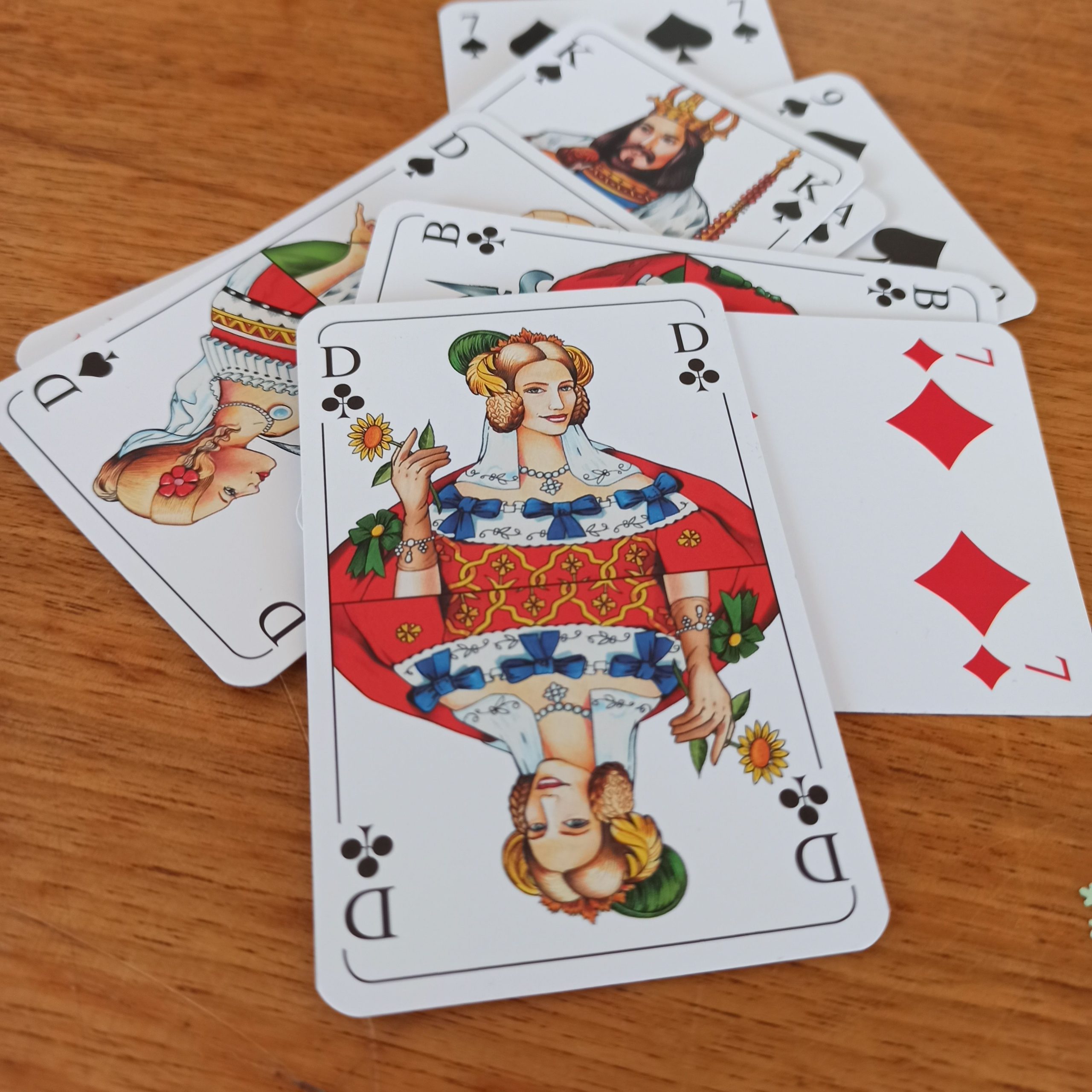
At a Singapore school carnival booth, a pupil puts four kinds of stamp cards face down and asks visitors to pick without looking. How many cards must a visitor take to be sure that at least two have the same symbol? The phrase to be sure changes the problem. It is not enough to show that a match can happen. You have to show that a match cannot be avoided. This upper primary maths puzzle for Singapore families uses cards to make that distinction visible, even for a child who has never heard the phrase “pigeonhole principle”.
Start with two groups and an unlucky draw
Take three red cards and three black cards from a standard deck. The numbers and suits do not matter yet; in this first round, only the colour counts. Keep the cards face down and ask how many a person would need to draw to guarantee a pair of the same colour. Do not put a drawn card back. Some children will answer two because the first two cards could both be red. Ask them to arrange the worst possible first two cards instead. They can put one red and one black on the table, proving that a pair is not certain after two.
Now turn over a third card. It must be either red or black. Red matches the red card already on the table, and black matches the black card. There is no third colour to keep the cards all different. Three is enough to guarantee a pair, and two was not enough. Both parts are important. Saying “it works with three” alone doesn’t prove that three is the smallest number.
Make the possible groups visible before counting
Return the cards and set out a larger stack containing cards from each of the four suits: hearts, diamonds, clubs and spades. This time the rule is to match a suit, not a colour. Draw four labelled spaces on paper. For as long as possible, place each card drawn into a different space. A visitor might draw a heart, a club, a diamond and a spade with no repeated suit. That possible draw shows why four is not a guarantee. But a fifth card has to fit in one of the four spaces already occupied, so a suit repeats.
A useful question here is “Did you count the number of cards in the deck or the number of groups?” For this task four is the number of groups, not a claim about how many cards are available. If someone adds a joker and treats it as its own type, agree on the rule before doing any arithmetic. Depending on which cards are present, the possible ways to postpone a match may change. The group labels matter because they tell the solver which cards can count as a pair.
Check a new goal instead of adding one by habit
Go back to red and black, with at least three of each colour available, and ask how many draws guarantee three of one colour. A child might say four because it is one more than the previous answer. Try to avoid a triple for four draws: two red and two black works. A fifth draw cannot keep both colours at two or fewer, so five guarantees a triple. Write the most unlucky arrangement beside the answer. It is a short way to show both why four can fail and why five must work.
Finally, let your child plan the next booth puzzle. They might cut out paper tickets with different fruit pictures or use counters in three colours. Before a partner solves it, ask them to state the matching rule, say whether draws go back into the stack, and check that there are enough items to carry out the worst-case example. To clear up the most common slip, finish by asking for one draw that could make an early pair and a separate explanation for when a pair must appear. A lucky example and a guarantee answer different questions.